THE TWIN BRIEF
A 120-degree day, three surprise guests, a hotel in Sodom you do not want to review, and a river that shows up out of nowhere. This week: the reading, three midrashim retold, a longer Dvar from the Ben Ish Chai on being humble like water, practical Sephardi halacha for a Shabbat full of guests, and full Bronx zmanim (plus: clocks fall back Saturday night). About a 10-minute read. Illustrated. Open the printable version →
This Week’s Reading
Parashat Vayera — Genesis 18:1–22:24
- Parasha: Vayera, Genesis 18:1–22:24
- Maftir: Genesis 22:20–24
- Haftarah (Sephardi): II Kings (Melachim II) 4:1–23. Ashkenazim read longer, 4:1–37. Elisha and the woman from Shunem: she hosts the prophet, gets promised a son, and has one. Sound familiar? Hospitality, then a baby, same as Avraham and Sarah.
- No special Shabbat this week. Shabbat Mevarchim (blessing the month of Kislev) is next week, Nov 7.
Teen summary: Three days after his brit milah, Avraham is sitting at his tent door in brutal heat when three travelers show up. He runs, bows, and throws a full feast. They’re angels: one announces that Sarah will have a son in a year, and Sarah, who is around 90, laughs. Hashem tells Avraham that Sodom is about to be destroyed, and Avraham argues like the best lawyer ever: 50 righteous people? 45? 40? 30? 20? 10? Not even ten. Two angels rescue Lot and his daughters; Lot’s wife looks back and becomes a pillar of salt. In Gerar, King Avimelech takes Sarah and gets warned in a dream to give her back. Yitzchak is born (“Everyone who hears will laugh with me,” 21:6). Hagar and Yishmael are sent away, and an angel shows Hagar a well. Avraham makes a treaty at Be’er Sheva. Then the biggest test of all: the Akeidah. Avraham takes Yitzchak up the mountain, an angel stops him at the last second, and a ram caught in the bush is brought instead. The parasha ends with family news, including the birth of Rivka (22:23). Spoiler for next week.
Parasha Stories
Three midrashim for teens
1. “I don’t believe you”
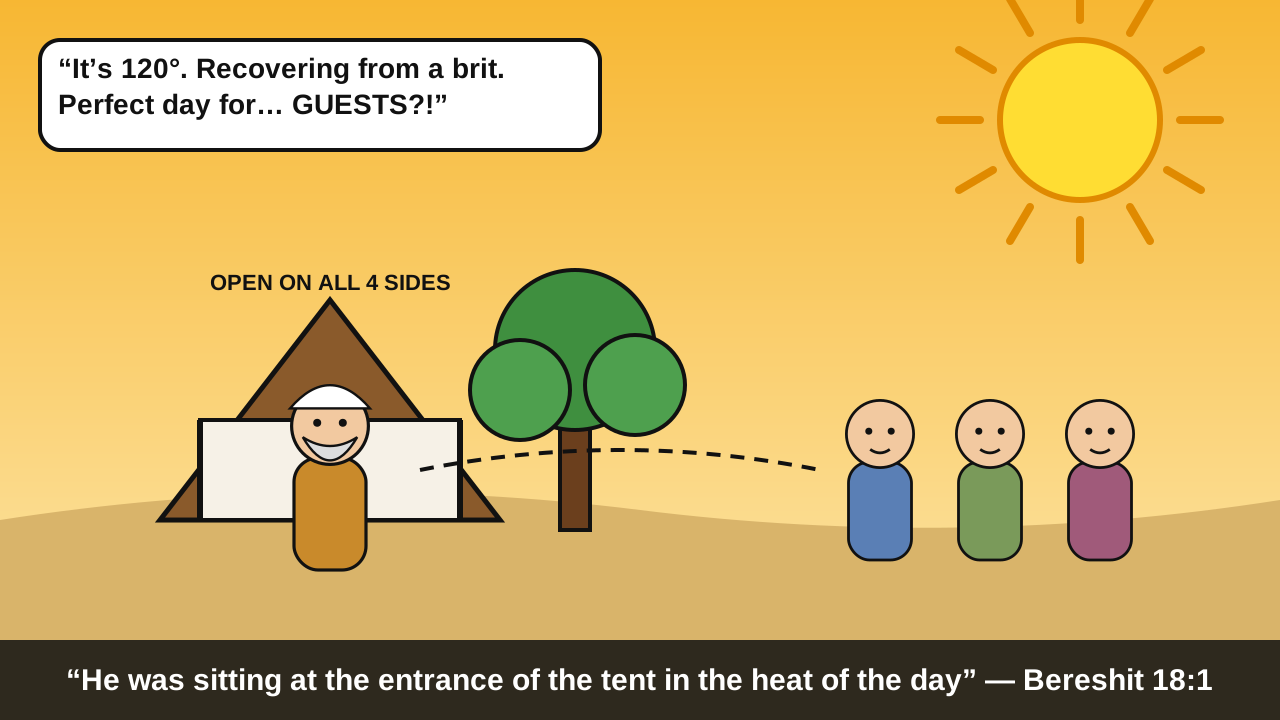
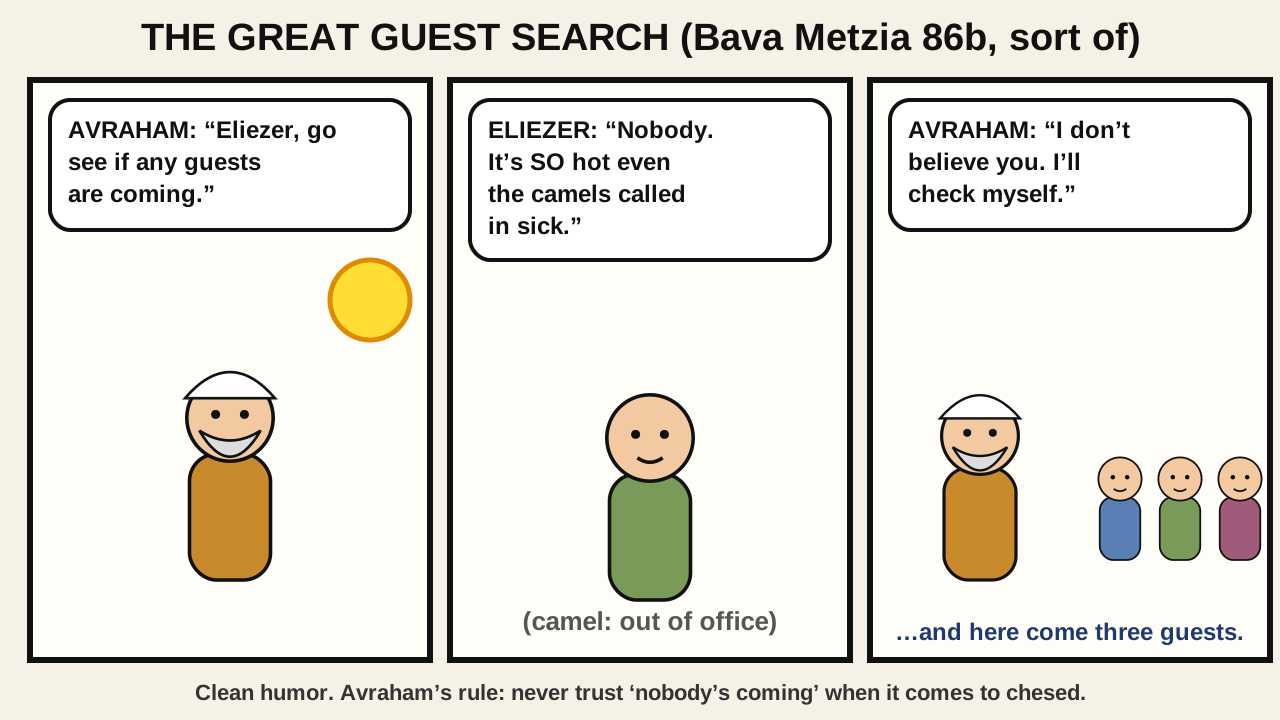
Why does the Torah say Avraham sat at the tent door “in the heat of the day” (18:1)? Bava Metzia 86b: it was the third day after his brit milah, the most painful day, and Hashem Himself came to visit the sick. To make sure no travelers would bother Avraham, Hashem “took the sun out of its sheath,” cranking the heat so nobody would be on the road. Avraham did not see a day off. He saw an empty guest list. He sent Eliezer out to look for travelers. Eliezer came back: “Nobody.” Avraham: “I don’t believe you.” He went out himself, sick and in the heat, and that’s when the three guests appeared.
Teen take: when you really care about something, you don’t outsource it and accept “nah, nobody’s there.” You go check yourself. Also: Hashem visiting Avraham is where we learn the mitzvah of bikur cholim. You visit sick people because Hashem does (Sotah 14a).
2. Sodom’s one-size-fits-all bed
Sodom wasn’t just “not nice.” It was evil with a system. Sanhedrin 109b says they had a special bed for guests. Too tall for the bed? They cut you down to size. Too short? They stretched you. Then Eliezer, Avraham’s servant, came to town. “Come lie on the bed.” Eliezer: “Sorry, I made a vow. Since the day my mother died, I don’t lie on beds.” Smoothest excuse in the Gemara.
Teen take: Avraham’s tent was open on all sides for anyone who came. Sodom made guests “fit” or else. Every friend group, team, and class picks one of those two models. Be the tent, not the bed.
3. The river that wasn’t on the map
On the way to the Akeidah, Midrash Tanchuma (Vayera 22) says the Satan tried everything. First he shows up as an old man: “Why are you bringing fire, a knife, and wood if you’re just going to pray?” Then as a young guy whispering to Yitzchak that his father had lost it. Both of them ignore him. So the Satan turns himself into a river right across their path. Avraham walks in: knees, waist, then water up to his neck. He cries out: “Master of the World, if I or my son drown, who will make Your Name known?” Hashem rebukes the source, the river dries up, and they keep walking. Last move: the Satan says, “I heard from behind the heavenly curtain that a lamb will be offered, not Yitzchak.” Avraham: “That’s a liar’s punishment. Even when he tells the truth, nobody believes him.”
Teen take: when you’re about to do something big and right, obstacles suddenly show up out of nowhere. Sometimes the “river” is just the yetzer hara in costume. Keep walking. (And if you build a reputation for honesty, people will believe you when it counts.)
Dvar Torah
Be Like Water
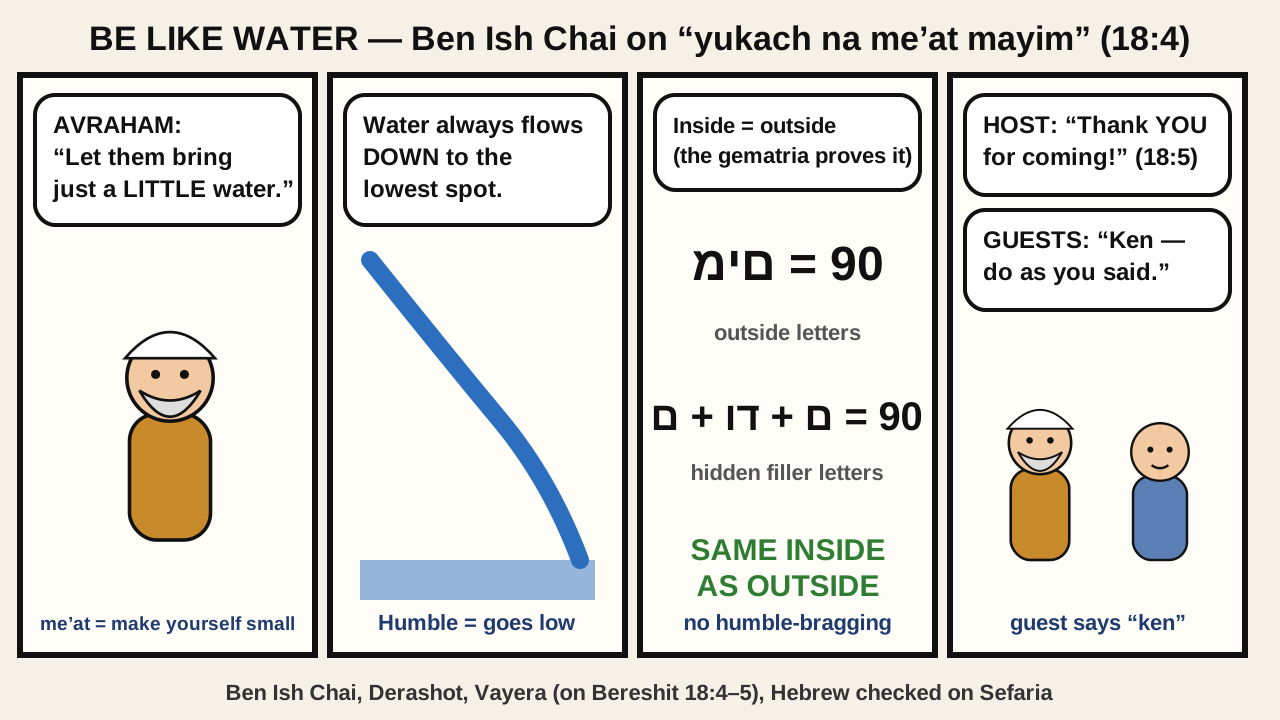
Avraham, host of the year, greets three dusty strangers with: “Yukach na me’at mayim, v’rachatzu ragleichem,” let a little water be brought, and wash your feet (18:4). The Ben Ish Chai, the great Sephardi Torah giant of Baghdad, asks the obvious question: why does a guy who’s about to serve a three-calf feast advertise “a little water”? He reads the verse as a hint about character.
“Me’at,” a little, is a hint to humility: a person should make himself small. But, he says, the humility has to be complete, inside and outside, like the letters of the word mayim (מים), water. Two reasons. First, water always flows to the lowest place. It never tries to climb on top of everything. Second, water is “tocho k’varo,” the same inside as outside, and he proves it with gematria. מים equals 40 + 10 + 40 = 90. Now spell out each letter in full: מ״ם, יו״ד, מ״ם. The hidden “filler” letters are ם, ו״ד, ם: 40 + 10 + 40 = 90. The inside of the word equals the outside. That’s the kind of humility he wants. Not “I’m sooo humble” on the outside while the inside is screaming “notice me.” (The Ben Ish Chai did not know the word humble-brag, but he invented the cure in the 1800s.)
“V’rachatzu ragleichem,” wash your feet, he reads as a hint to cleaning off the sins a person “tramples with his heels,” the little ones we step on and don’t even notice, which are exactly where the yetzer hara gets you most. Big sins you see coming. It’s the “it’s not a big deal” stuff that piles up.
“V’ekcha pat lechem,” I’ll get a piece of bread (18:5). The Ben Ish Chai says pat hints at two, meaning Avraham planned to bring two loaves, like the lechem mishneh of a Shabbat meal, because he treated feeding guests as a full seudat mitzvah. So every time you see two challahs on the table this Shabbat, picture Avraham setting up for three strangers like it was Shabbat.
“Ki al ken avartem al avdechem,” “for you have passed by your servant.” Two readings from him. One: Avraham is saying, you did me the favor by coming. I’m getting more out of this than you are. Two: “al ken” can be read “on condition of ken,” yes. Derech eretz says that whatever the host asks, the guest says “yes” and doesn’t argue (the Gemara’s rule in Pesachim 86b: whatever the host tells you, do it). And look at the very next words in the Torah: the guests answer, “Ken ta’aseh ka’asher dibarta,” yes, do as you said. They passed the test.
Put it together and you get a full guide to being a mensch at a Shabbat table. Host: be humble like water, low and real, the same inside as outside, and act like the guest is doing you a favor. Guest: say “ken.” Eat the kugel. Don’t argue about where you’re sitting.
Teen takeaway: be like water. Go low, stay real, and make sure the inside of you matches the outside.
Source: Ben Ish Chai, Derashot, Parashat Vayera, on Bereshit 18:4–5 (“yukach na me’at mayim”), Hebrew checked on Sefaria (Ben Ish Hai, Drashot, Vayera 2); Pesachim 86b. Gematria spelled out in-house. Written in-house for teens. Teen reference, not a personal ruling.
Practical Halacha · Sephardi / Shulchan Aruch / Yalkut Yosef
This Shabbat’s checklist
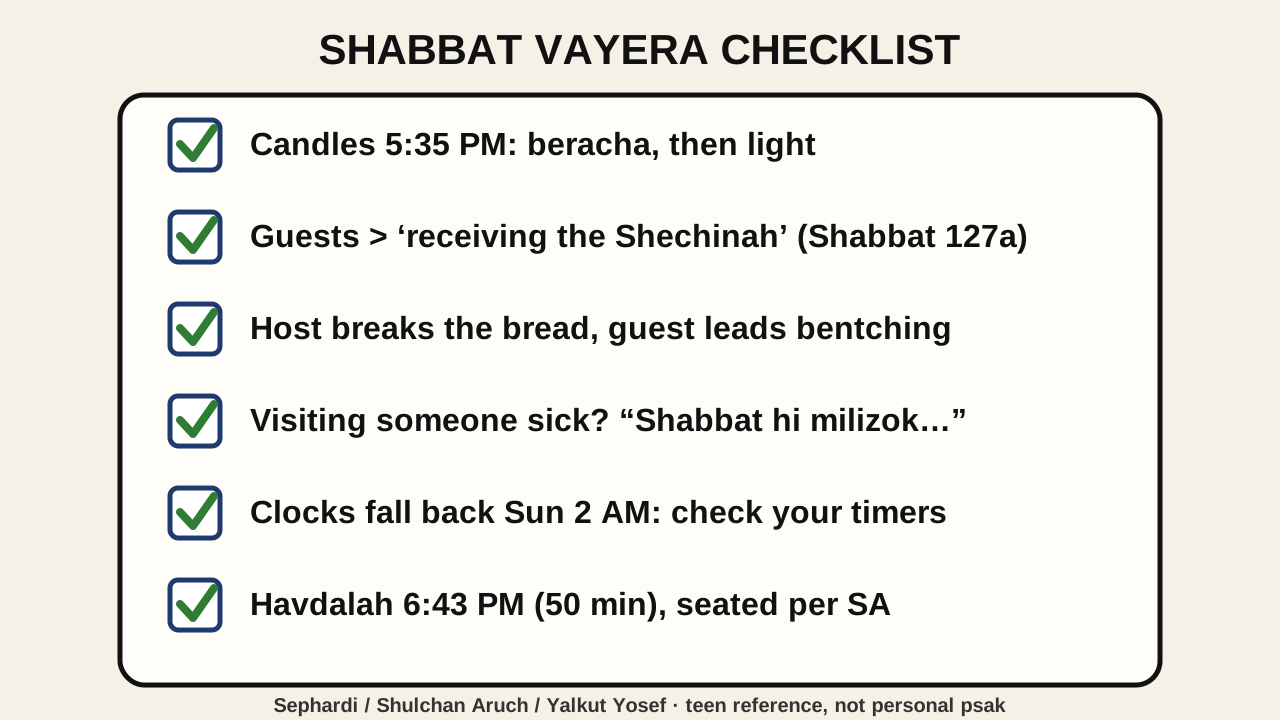
- Candles, beracha first: the Shulchan Aruch gives the beracha “l’hadlik ner shel Shabbat” (OC 263:5), and Sephardi practice, as Yalkut Yosef rules, is to say the beracha and then light. Lighting first and covering the eyes is the Rema’s Ashkenazi custom. Candles this week: 5:35 PM.
- Guests are a big deal, even on Shabbat: Rav says hachnasat orchim is greater than receiving the Shechinah (Shabbat 127a), learned from this week’s parasha, where Avraham asks Hashem to wait while he runs to the guests. It’s big enough that on Shabbat you may even start clearing out a storeroom of boxes to make room for guests (OC 333:1), something not normally allowed.
- Host breaks the bread, guest leads bentching: the host makes hamotzi and cuts, even if the guest is greater (OC 167:14). For Birkat Hamazon it flips: the guest leads, so he can bless the host. The Shulchan Aruch even gives the text, that the host should never be embarrassed in this world or the next, and that his business succeed (OC 201:1). The host can choose to bentch himself.
- Bikur cholim on Shabbat: visiting a sick person is allowed on Shabbat. You don’t talk the weekday way. Instead you say: “Shabbat hi miliz’ok, u’refuah kerovah lavo, v’rachamav merubim, v’shivtu b’shalom” (OC 287:1). The Shulchan Aruch includes v’rachamav merubim; the Rema says the Ashkenazi custom drops it. This is the parasha where Hashem Himself visits the sick.
- Clocks fall back: DST ends Sunday Nov 1 at 2:00 AM, after Shabbat is over, so Shabbat times are not affected. But if you have a Shabbat timer or an alarm for Sunday minyan, check it before candle lighting, and remember that Sunday morning comes an hour “later” on the clock. Next Friday’s candles drop to 4:27 PM.
- Havdalah, sitting: the Shulchan Aruch says Havdalah is said sitting (OC 296:6); the Rema notes the Ashkenazi custom to stand. Shabbat ends at 6:43 PM (50 min).
Teen reference only, not personal psak. Ask a rav for your household.
Zmanim · Bronx NY 10471 · ET
Full Shabbat times
Fri Oct 30 · Erev Shabbat Vayera / 19 Cheshvan
- Candle lighting: 5:35 PM
- Sunset: 5:54 PM (candles 18 min before)
Sat Oct 31 · Shabbat Vayera / 20 Cheshvan
- Sunrise: 7:25 AM
- Latest Shema: 9:26 AM (Magen Avraham) / 10:02 AM (Gra)
- Latest Tefillah: 10:30 AM (MGA) / 10:54 AM (Gra)
- Chatzot: 12:39 PM
- Mincha gedola: 1:05 PM
- Plag hamincha: 4:47 PM
- Sunset: 5:53 PM
- Shabbat ends / Havdalah: 6:43 PM (Hebcal Bronx, 50 min)
Calendar FYI
- Clocks fall back one hour Sun Nov 1, 2:00 AM (Eastern Standard Time starts).
- Keep saying mashiv haruach u’morid hageshem. V’ten tal u’matar (Diaspora) starts at Maariv Fri night Dec 4, 2026.
- Next week: Parashat Chayei Sarah + Shabbat Mevarchim Kislev · candles Fri Nov 6 4:27 PM · Havdalah Sat Nov 7 5:35 PM (50 min) · Rosh Chodesh Kislev Tue–Wed Nov 10–11
Times from Hebcal for Bronx 10471 (America/New_York). Havdalah at 50 minutes per household practice. Confirm with your community custom.
Illustration
The heat of the day
Closing Comic
The great guest search
Prefer paper? Print this edition (letter size, B&W-friendly)